
Health benefits of NIR light are well-documented in photobiology, and they are tied to how the near-infrared photons interact with our skin, deep tissue, and mitochondria.
To understand the health benefits of NIR—even when the bulb isn’t physically hot—we have to distinguish between radiant heat (like a heat lamp or an incandescent bulb) and biological heat (a physiological response).
Here is the breakdown of the heath benefits of NIR-enhanced bulbs:
1. The Mitochondrial Connection (Photobiomodulation)
The mitochondria is the primary driver of the NIR health benefits from NIR-enhanced bulbs.
- The Mechanism: NIR light (specifically in the 650–950nm range) penetrates the skin and is absorbed by an enzyme in our mitochondria called Cytochrome C Oxidase (CCO).
- The Nitric Oxide Release: When CCO absorbs NIR light, it releases bound Nitric Oxide (NO).
- Vasodilation: Nitric oxide is a powerful vasodilator. It signals the blood vessels in our skin and underlying tissue to widen. This increases local blood flow, bringing more warm blood from our core to the surface of our skin.
- The Result: This increased circulation creates a distinct, glowing sensation of warmth. You aren’t just feeling the light; you are feeling your own increased blood flow responding to the light.
2. Deep Tissue Absorption vs. Surface Reflection
Visible-only light (from a standard LED bulb) interacts mostly with the very top layers of our skin. Much of it is reflected or scattered.
- NIR light, however, falls into what scientists call the “optical therapeutic window” (roughly 650nm to 1350nm). In this range, light bypasses melanin and hemoglobin and penetrates several centimeters or inches deep into tissue before being absorbed by water and cellular structures.
- When these deeper tissues absorb the NIR photons, the photon energy is converted into vibrational energy (micro-heat). While the NIR-enhanced bulbs don’t emit enough power to physically heat you, this deep, localized absorption is enough to stimulate the thermal receptors in your deeper skin layers that standard visible light never reaches.
3. Neurological Signaling (TRP Channels)
Your nervous system has specific ion channels that detect temperature, known as TRP channels (Transient Receptor Potential channels).
- Research suggests that certain wavelengths of red and NIR light can directly modulate or sensitize these nerve endings (specifically TRPV1 and TRPV3/4 channels, which are responsible for sensing warmth and heat).
- This means the NIR light might be literally “tricking” or stimulating your sensory nerves into sending a “warmth” signal to your brain, even if the actual physical temperature of your skin hasn’t risen drastically.
4. Why Standard LED Bulbs Don’t Provide NIR Health Benefits
A standard LED is engineered to mimic the visible spectrum of daylight. It emits almost zero Near-Infrared light and minimal deep red therapy light.
- When you stand under a standard LED, your skin only reacts to the visible light (which mostly reflects) and the tiny amount of physical heat radiating from the bulb’s electronics.
- When you stand under an NIR-enhanced LED bulb, your eyes see the exact same white light, but your skin and mitochondria are suddenly being bathed in invisible NIR photons, triggering the vascular and neurological responses mentioned above.
Summary: It’s a Biological Reaction, Not Just a Physical One
If you stand under a traditional incandescent “heat lamp,” you feel hot because the bulb is physically blasting your skin with Mid- and Far-Infrared radiation (Mid-IR and Far-IR), which violently vibrates water molecules (radiant heating) and can even cause skin burns.
However, the NIR-enhanced LED bulbs only produce beneficial full spectrum near-IR similar to what we experience in nature. Therefore, the “warmth” users feel is almost entirely a biological feedback loop: the NIR light hits your mitochondria, releases nitric oxide, dilates your blood vessels, and stimulates your deep-tissue muscles and thermoreceptors.
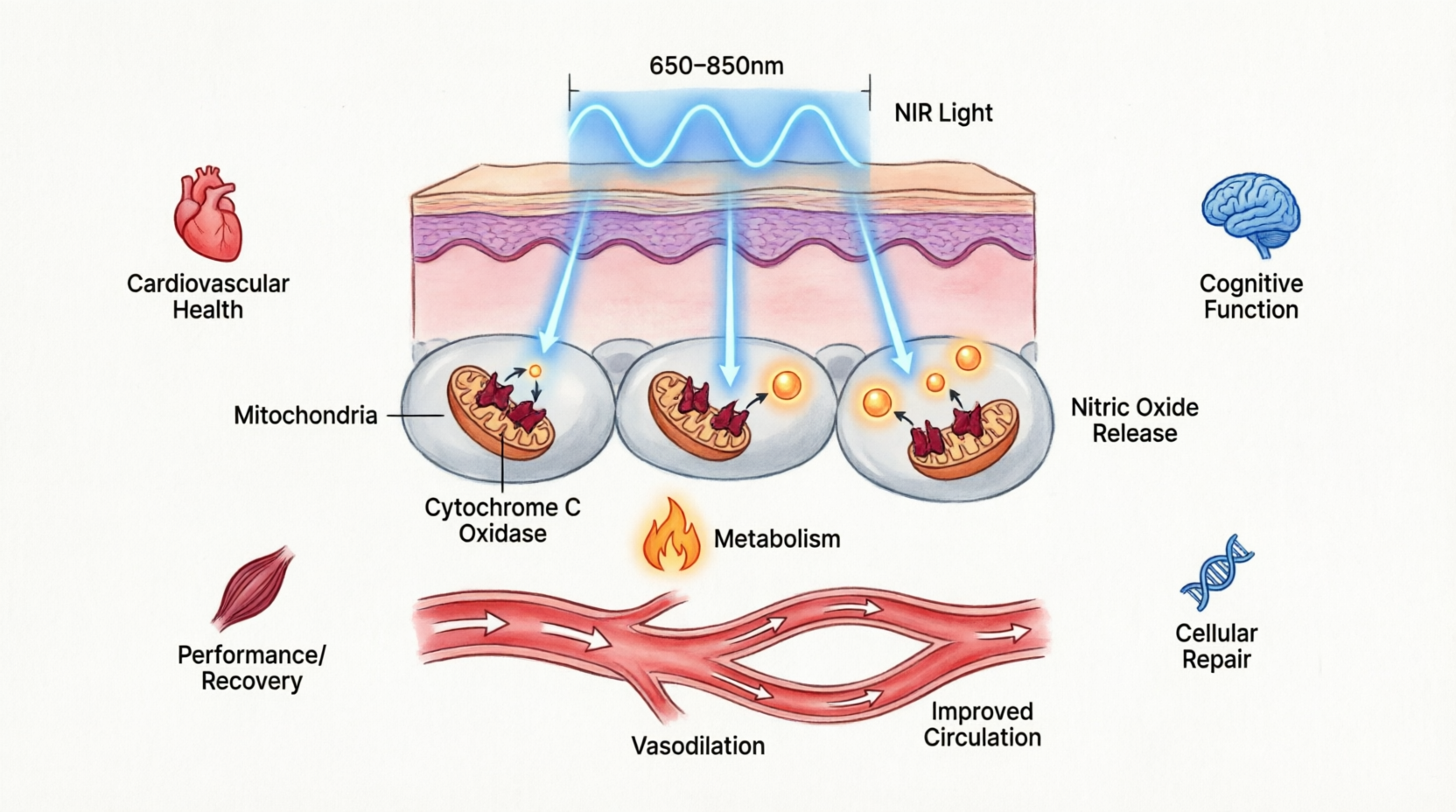
Summary of the NIR health benefits