
 Circadian light is a term used for artificial lighting that mimics natural daylight to support the body’s circadian rhythm. This can help improve sleep quality and energy levels, even contribute to better health and healing from a wide range of medical conditions caused by mitochondrial dysfunction. Circadian lighting uses different correlated color temperatures (CCTs) throughout the day, with cooler (high CCT) colors in the morning and warmer (low CCT) colors in the evening. Although invisible and do not contribute to the color of light our eyes can perceive, invisible ultraviolet (UV) and infrared (IR) light also play a key role in regulating our body’s biological and chemical responses. Natural sunlight contains around 5% UV and between 50-55% IR radiation. Just like natural sunlight, artificial circadian lighting uses brighter light in the morning and early afternoon and dimmer light in the evening.
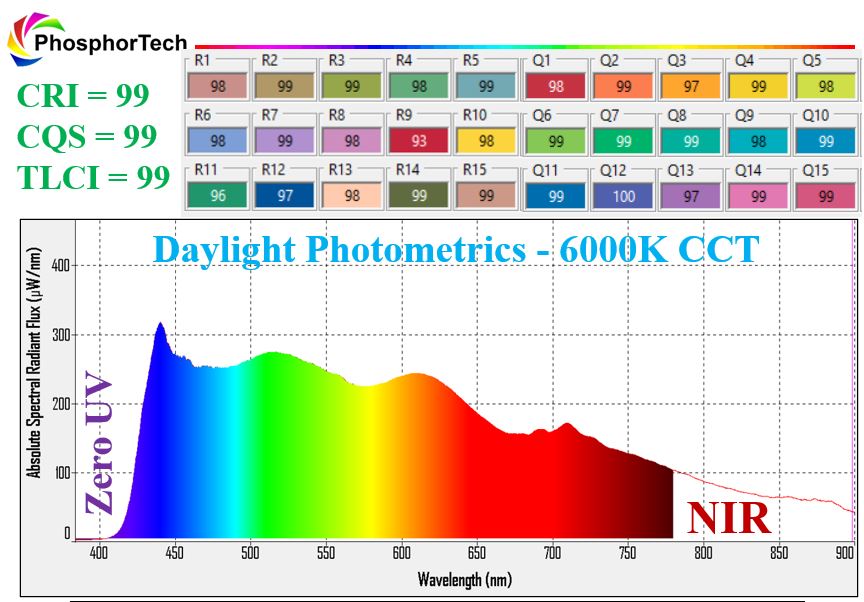
A UV-free Vis-NIR solar spectrum using phosphor-converted blue LEDs is used as a circadian light engine
Circadian Light Benefits
Circadian lighting can help balance the sleep-wake cycle by mimicking what our bodies have been accustomed to from natural sunlight. This approach to lighting can improve sleep quality, increase energy levels, improve focus, and promote overall health. Circadian lighting can be used in homes, offices, healthcare clinics, and educational facilities. It is particularly important for people who do not spend enough time outdoors in the sun since it helps regulate the indoor body by exposing it to similar wavelengths and energy ratios of light that are typically available outside. For example, proper circadian lighting requires avoiding high levels of blue light in the evening while using amber-colored lighting to promote sleepiness. Infrared light is also important in the evening since the solar spectrum during the late afternoon and early evening provides a significant amount of IR light.
Tunable circadian light engine that uses phosphor-converted violet/blue LEDs to provide a full color spectrum resembling sunlight, including near-infrared