
The most effective way to build a broadband LED is to use a phosphor-converted (pcLED) system. Phosphor conversion can be used to transform narrow-band UV sources into a broadband near-UV LED, a UV-Vis LED, or a UV-Vis-NIR LED. Similarly, phosphors are used to convert narrow visible LEDs and/or lasers into broadband Vis-NIR and Vis-NIR-SWIR sources, as illustrated below.
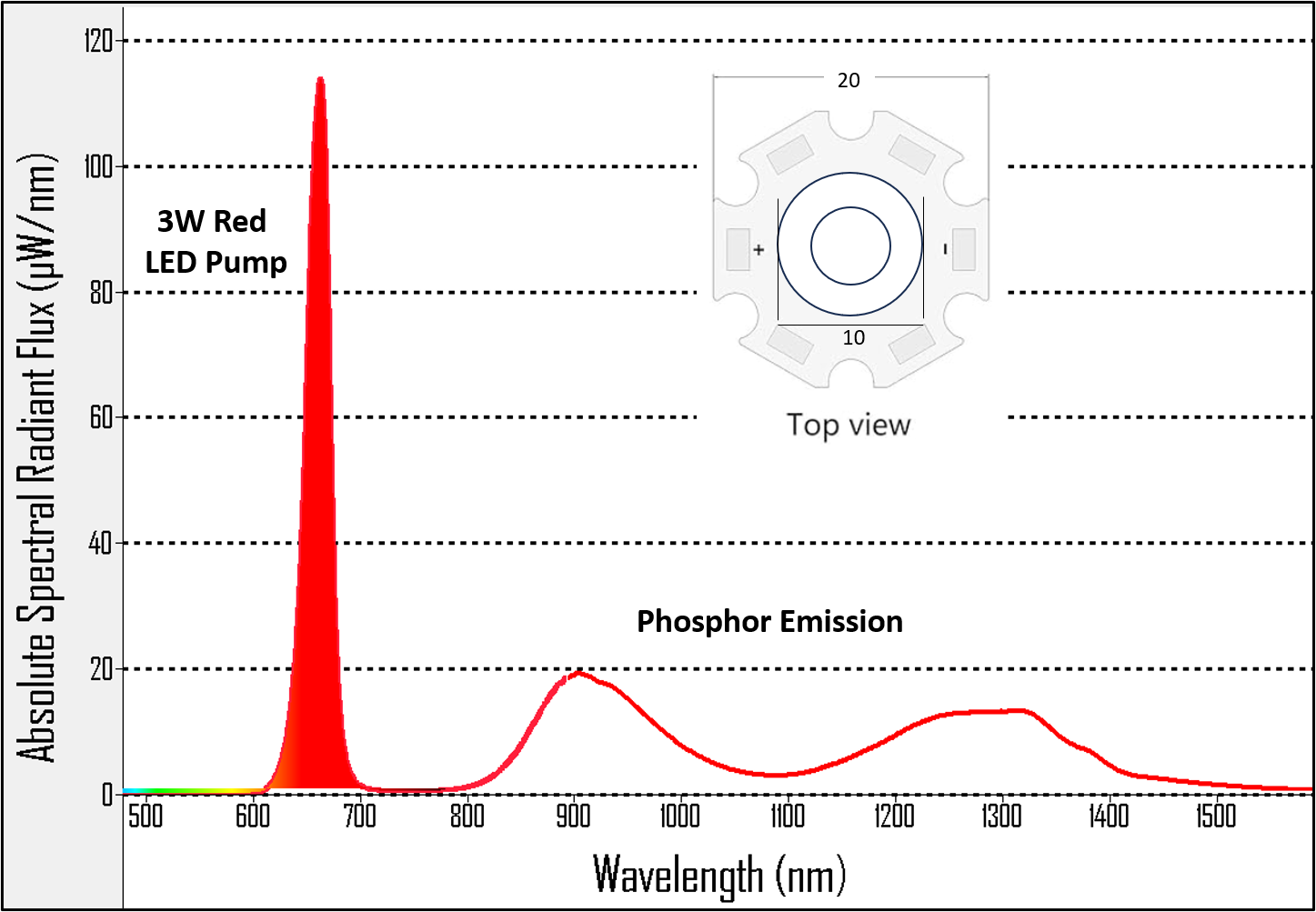
A red LED combined with infrared phosphors to create a broadband Vis-NIR-SWIR source
We can customize and fabricate a wide range of broadband LED sources for stable and high-power illumination. Unlike traditional broadband sources using xenon or mercury-xenon bulbs, the phosphor-converted LEDs can deliver continuous full spectrum sources using advanced solid-state lighting technologies. The sources can be supplied with DC or AC power supplies that feature current controllers and thermal design with effective heat dissipation to achieve highly stable output and constant PC board and junction temperature. This helps protect the LEDs from thermal damage and minimize phosphor thermal quenching.
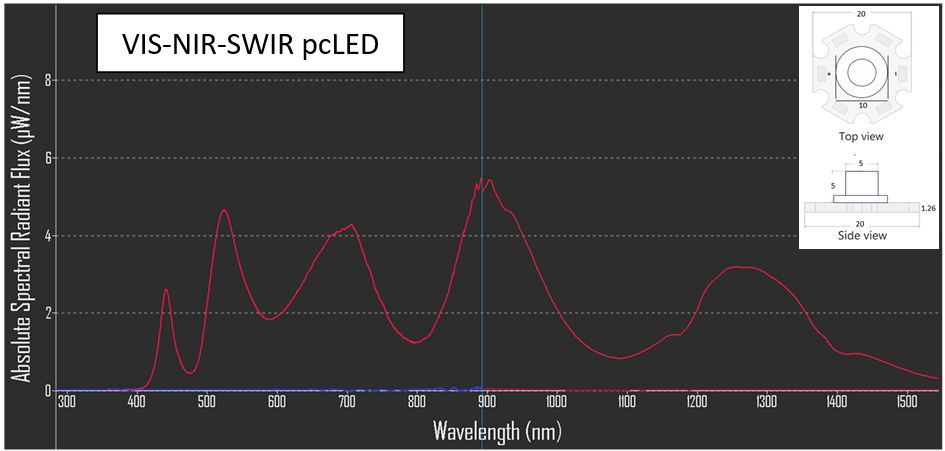
Broadband Vis-NIR-SWIR pcLED (3W VIS-SWIRLED)
You can purchase the above 3W VIS-NIR-SWIR pcLED by scanning or clicking on this QR code below.

A broadband and stable pcLED source is ideal for compact and portable optical and fiber optic spectroscopy measurements. It consumes significantly less electrical power and generates less heat and higher optical power density (mW/mm2) compared to traditional UV/Vis/NIR sources. Typical UV/Vis/NIR sources used in spectroscopy (deuterium lamp, for example) can consume around 25W while producing less than 1mW of optical power. A typical broadband LED source can consume less than 3W while delivering 50-100 mW in optical power over a smaller area for more effective coupling to lenses and fiber optic cables. Having a small footprint, pcLEDs can be integrated into a wide range of optical equipment or be used as part of a detector calibration system. The only power supply needed is an external DC or USB power source. Most pcLEDs are also dimmable using an external DC controller board or pulse width modulation (PWM) signals.